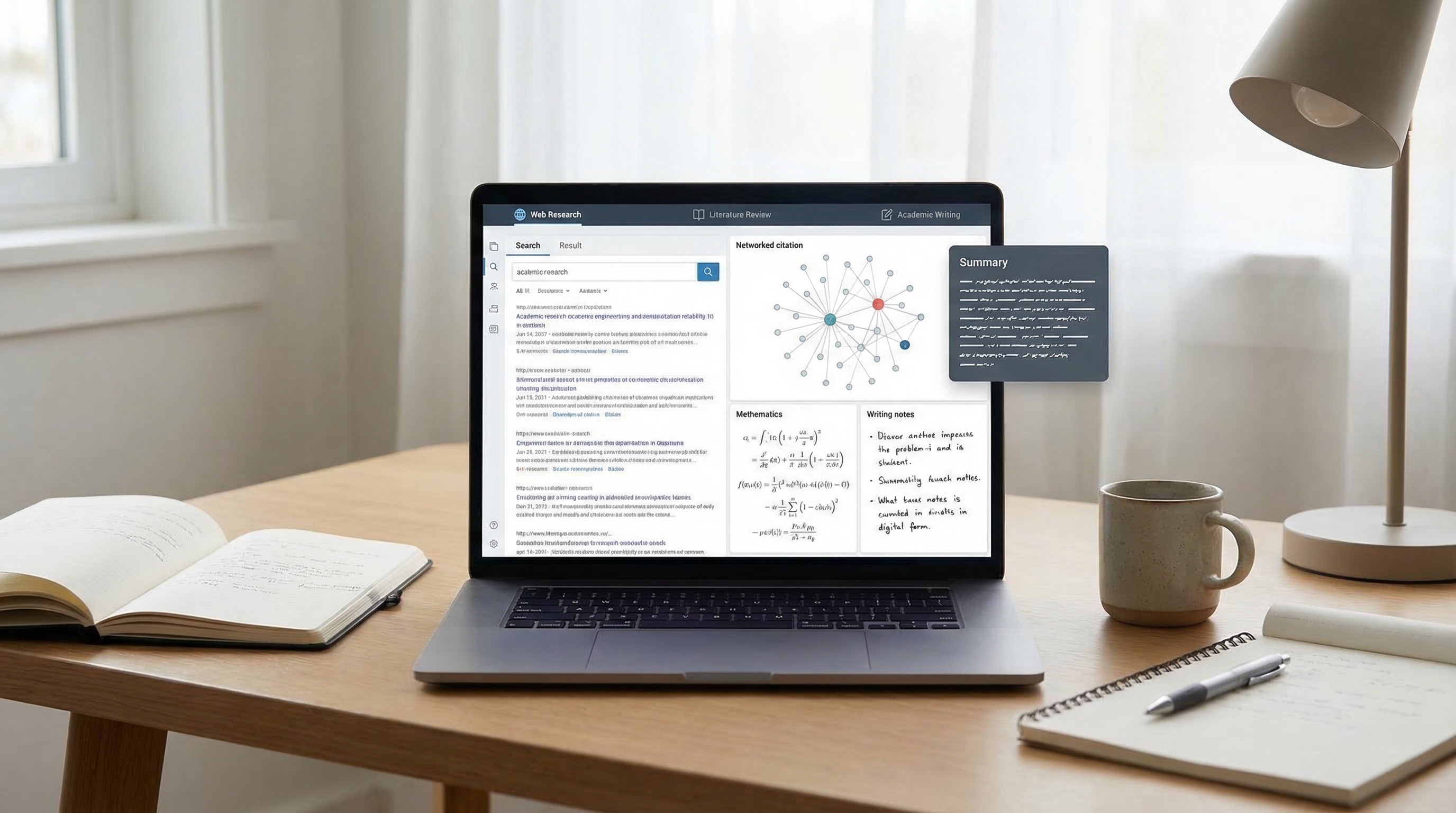
The term AI-powered research assistant sounds precise, but it actually covers several different kinds of tools. Some are built to search the web and produce fast topic overviews. Some work best when you upload your own documents and want source-grounded answers. Others focus on academic literature, citations, and evidence review. That is why comparing them all as if they do the same job usually leads to bad expectations.
A better approach is to ask a simpler question: what kind of research help do you actually need? If you need broad online synthesis, one type of tool makes sense. If you need paper discovery and citation context, another type is stronger. If your problem is understanding equations, clarifying dense material, or polishing academic writing, a platform like AI Scholar GPT may be more useful as a research companion than as a literature-search engine.
Why AI research assistants are not all solving the same problem
The current landscape can be understood in three broad groups.
The first group is the web-wide research assistant. These tools are designed to search across online sources, summarize findings, and give users a fast starting point on a topic. This is where tools like ChatGPT deep research, Gemini Deep Research, and Perplexity are most often discussed.
The second group is the source-grounded research tool. These tools work best when the user already has documents, notes, PDFs, or project files and wants an assistant that can reason from those materials instead of browsing broadly. NotebookLM is one of the clearest examples of this category.
The third group is the academic literature assistant. These tools are designed around papers, citations, and evidence workflows. Elicit, Consensus, Scite, Semantic Scholar, ResearchRabbit, and Connected Papers all belong here, though each does something slightly different.
Once you separate the category this way, the market becomes easier to understand. The question stops being “Which AI research assistant is best?” and becomes “Which type of research assistant fits this stage of my work?”
Web-wide assistants are best for broad exploration
Web-wide assistants are often the most visible because they are easy to try and useful for many general questions. They are strong when you need a broad overview, a quick market scan, an industry briefing, or a first-pass understanding of an unfamiliar topic.
That is the main appeal of tools like ChatGPT deep research, Gemini Deep Research, and Perplexity. They are built for speed, breadth, and synthesis. They help users map a subject quickly and identify useful sources without manually opening dozens of tabs.
Their biggest strength is also their main limitation. Because they operate at broad scope, they are excellent for starting research, but they still require judgment. Users need to verify sources, check framing, and be careful not to confuse a polished summary with a final authority.
In other words, these tools are strongest at orientation. They help you see the landscape. They are not automatically the best tools for citation-heavy academic review, evidence auditing, or deep source-grounded analysis.
Source-grounded tools are strongest when your own materials matter
A different kind of research problem appears when the user already has the sources. A student may have a stack of readings. A team may have PDFs, notes, or internal reports. A researcher may have a folder of papers and want fast question answering tied directly to those materials.
That is where source-grounded tools stand out. Instead of searching the entire web, they work from the documents you provide. This usually makes them more useful when accuracy needs to stay close to a known source set.
NotebookLM is one of the clearest examples of this approach. It is less about broad discovery and more about helping users understand, summarize, connect, and reason from their own materials.
This is also a good place to understand where AI Scholar GPT can be helpful. It is not positioned as a giant paper index or citation graph engine. Instead, it works better as an academic support layer around the research process. If you have already gathered material and now need explanation, clarification, or academic follow-up help, it becomes easier to see its role.
Academic literature assistants are best for papers and evidence workflows
Academic literature assistants are the most specialized part of this category. They are built not just to answer questions, but to help users search scholarly material, compare findings, trace citations, and review evidence more systematically.
Elicit and Consensus are often discussed together because both are closely tied to academic search and research synthesis. They are useful when the job is finding relevant literature and quickly understanding what that literature says.
Scite adds a different value. It is especially useful when the context of a citation matters. Sometimes a paper is frequently cited, but the important question is whether later work supports it, disputes it, or simply mentions it. That makes citation context a meaningful feature, not just a bonus.
Semantic Scholar is often valuable as a large-scale paper discovery tool. ResearchRabbit and Connected Papers are especially helpful when users want to explore relationships between papers visually, follow clusters of work, or move outward from one seed paper into a wider map of a field.
These tools are particularly strong for literature review and academic discovery, but they are not always the best at everything that happens after discovery. Once you have found the papers, you may still need help understanding technical parts, rewriting notes, or clarifying dense sections of your own writing. That is where a companion platform can become useful.
Where ScholarGPT AI fits most honestly
The most accurate way to describe ScholarGPT AI is not as a replacement for every other research assistant. It is better understood as a research companion for academic workflows.
That distinction matters. If someone expects a full academic search engine with giant literature indexing, citation graphs, and evidence-mapping features, they may be comparing ScholarGPT AI to the wrong category. But if the user needs help understanding material, working through technical obstacles, or improving research writing, the platform fits more naturally.
That is why AI Scholar GPT makes sense as a support layer around research rather than as the sole research engine. It can help students, researchers, and academic writers move from confusion to clarity once the source-gathering stage is already in motion.
Use AI Math Solver when research turns technical
Not every research problem is about finding more papers. Sometimes the real obstacle is mathematical reasoning. A student may understand the topic but get stuck on a derivation. A researcher may need to double-check a formula-heavy section. A writer may need help unpacking a statistics-heavy passage before summarizing it accurately.
That is where AI Math Solver becomes especially practical. It fits the part of academic work where formulas, step-by-step reasoning, or quantitative clarity matter more than broad discovery.
This is an important reminder that research assistance is not only about search. In many fields, understanding the math is part of understanding the research. A tool that helps explain steps, logic, and formal reasoning can therefore play a meaningful role in the workflow, even if it is not a paper-search platform.
Use AI Rewrite Text when your ideas are right but your phrasing is weak
Another common research problem appears after the reading stage. You understand the source material, but your notes are clumsy, your summary is dense, or your draft sounds awkwardly mechanical. That is not a search problem. It is a writing problem.
This is where AI Rewrite Text becomes useful. It can help polish literature summaries, rephrase explanations, improve clarity in proposals, and rewrite dense passages into more readable academic prose.
Used carefully, this kind of tool is not about replacing thinking. It is about improving expression. That matters because a lot of academic frustration comes from the gap between what someone understands internally and what they can explain clearly on the page.
Later in the workflow, a tool like Text Rewriter AI can also help normalize tone across a document, tighten overly wordy sections, or make technical explanations easier for a broader audience to follow.
A practical workflow that combines different research assistants
The most realistic research workflow today is modular. One tool rarely does everything equally well.
A strong process might look like this: start with a broad research assistant to map the topic. Then move to academic literature tools for papers, citations, and evidence review. After that, use AI Scholar GPT when you need academic explanation or subject clarification. If the work becomes formula-heavy, shift to ScholarGPT Math Solver. When your notes or draft sections need polish, finish with Text Rewriter AI.
This kind of workflow is more honest than pretending one platform can replace every part of the research process. The category is already specialized, and users get better results when they choose tools according to stage rather than brand loyalty.
Who should use which kind of research assistant?
If your main need is broad exploration, web-wide assistants are usually the best fit. If your work depends on your own uploaded materials, source-grounded tools are more useful. If you are doing literature review, citation checking, or evidence comparison, academic research assistants are the strongest choice.
ScholarGPT AI fits best for users who need academic support around those stages rather than a substitute for them. Students, technical learners, and researchers who need help with explanation, math-heavy reasoning, or rewriting are more likely to benefit from AI Scholar GPT than users who only want a giant paper-search engine.
Final takeaway
There is no single best AI-powered research assistant because there is no single research problem. Some tools are designed for web-scale exploration. Some are best for source-grounded document analysis. Some focus on academic papers and citation workflows. Others, like ScholarGPT AI, are more useful as companions for explanation, reasoning, and writing refinement.
That makes the smartest choice a practical one. Use broad research assistants to explore. Use literature tools to verify and review evidence. Use AI Math Solver when technical reasoning becomes the bottleneck. Use AI Rewrite Text when your writing needs clarity more than your ideas need discovery.
In that sense, the real value of AI-powered research assistants is not that one tool does everything. It is that the right combination of tools can make research faster, clearer, and easier to manage.
Reading recommendation
If you want to keep exploring this topic, these related articles on ScholarGPT AI are a useful next step: