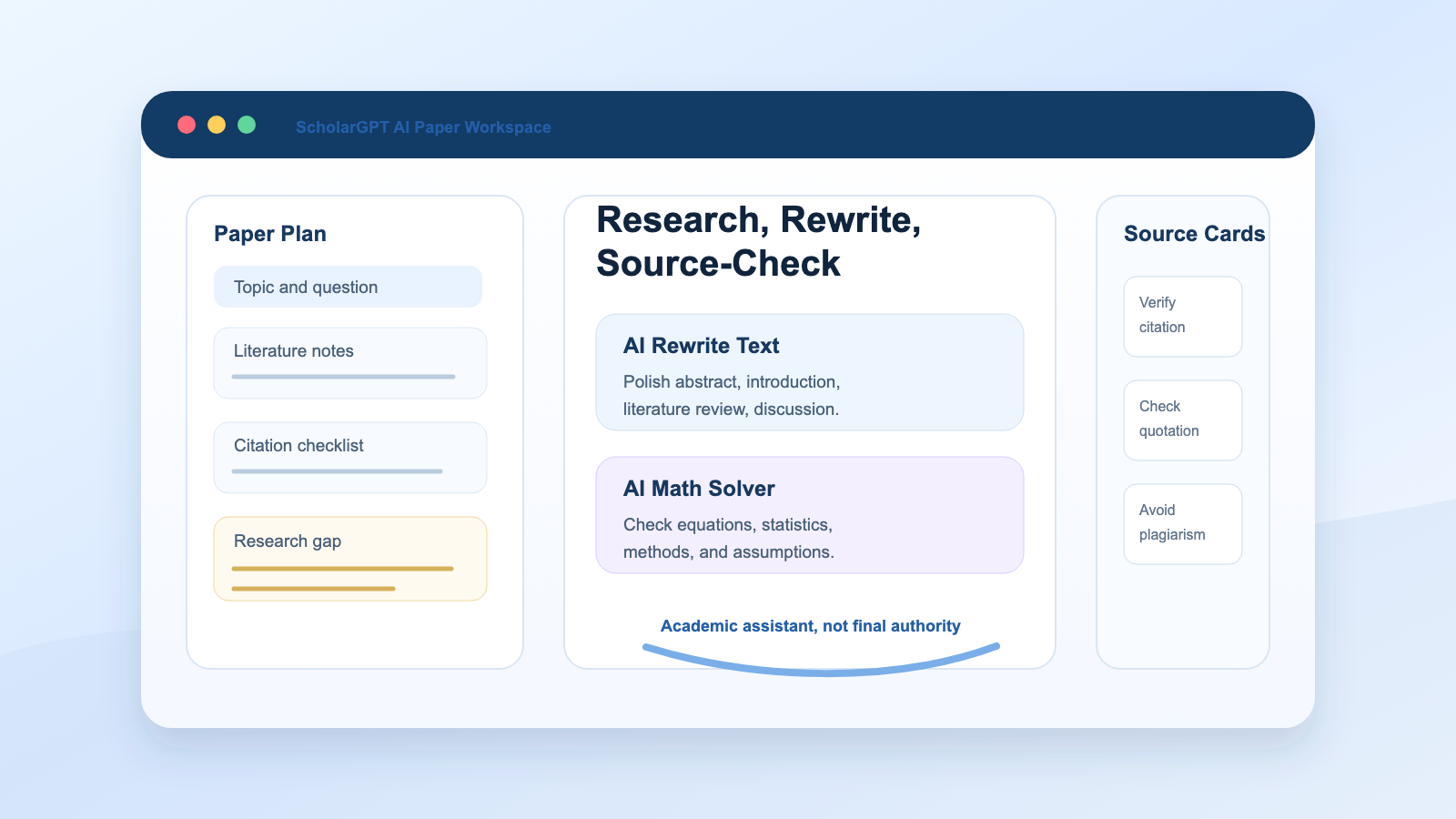
If you are trying to use Scholar GPT for a paper, the safest workflow is not "ask AI to write the paper." A better approach is to use ScholarGPT AI as an academic assistant for planning, reading support, outline structure, rewriting, math or methods checking, and final source review while you keep responsibility for evidence, citations, originality, and academic policy.
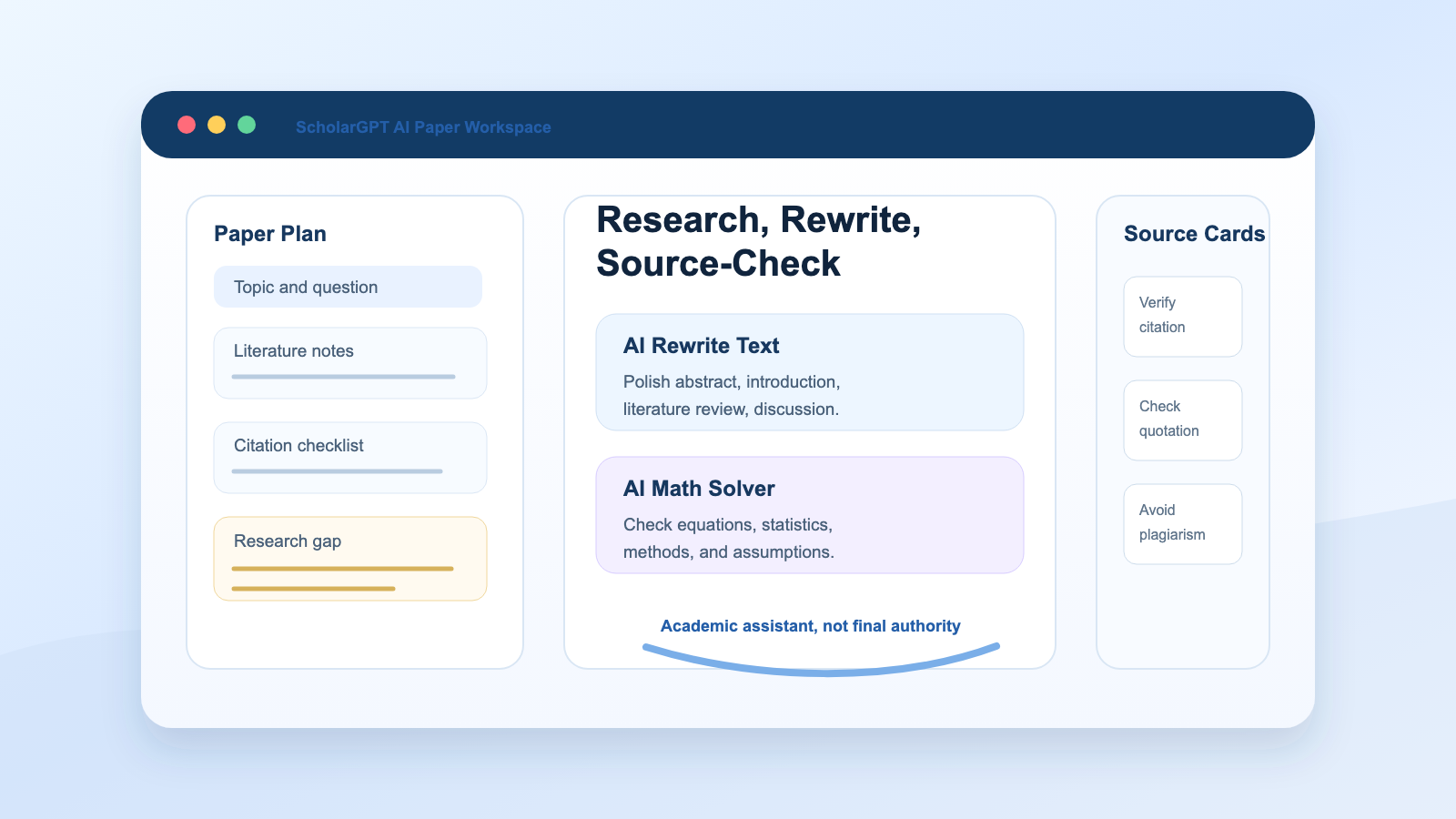
This guide is written for students, academic writers, researchers, and teachers who want a practical Scholar GPT paper writing workflow. It also clarifies a common naming issue: Paperguide's Scholar GPT is a research-focused tool for literature discovery and citation-backed answers, while Scholargpt.ai can be positioned as a broader academic assistant for rewriting, math solving, study support, and paper workflow refinement.
Quick Summary: What Scholar GPT Can and Cannot Do for Papers
Scholar GPT for papers is most useful when you treat it as support for thinking and revision, not as a final academic authority. It can help you turn a broad topic into research questions, organize sections, explain difficult passages, rewrite unclear paragraphs, review equations, and create a checklist for source verification.
The caution is just as important. AI tools can produce unsupported claims, inaccurate citations, overconfident summaries, or polished text that does not match your evidence. Before submission, verify citations against original sources, check quotations line by line, avoid plagiarism, follow your school or journal's AI policy, and disclose AI assistance when required.
How ScholarGPT AI Fits Into a Responsible Paper Workflow
The best way to use Scholar GPT academic assistant features is to separate the paper process into stages. Do not ask for a finished essay first. Start with research planning, move into reading and note organization, then use rewriting and source-checking after you already have your own argument and evidence.
A practical workflow looks like this:
- Define the topic, assignment requirements, and research question.
- Use an AI research assistant to brainstorm search keywords, possible angles, and evidence types.
- Read original sources yourself and keep citation details in a reference manager or notes file.
- Ask ScholarGPT AI to organize notes into themes, gaps, methods, or section outlines.
- Draft in your own words, then use AI Rewrite Text to polish clarity and flow.
- Use AI Math Solver for equations, statistical reasoning, homework-style problems, or method explanations that need step-by-step review.
- Run a source-checking pass before submission and verify every claim that needs evidence.
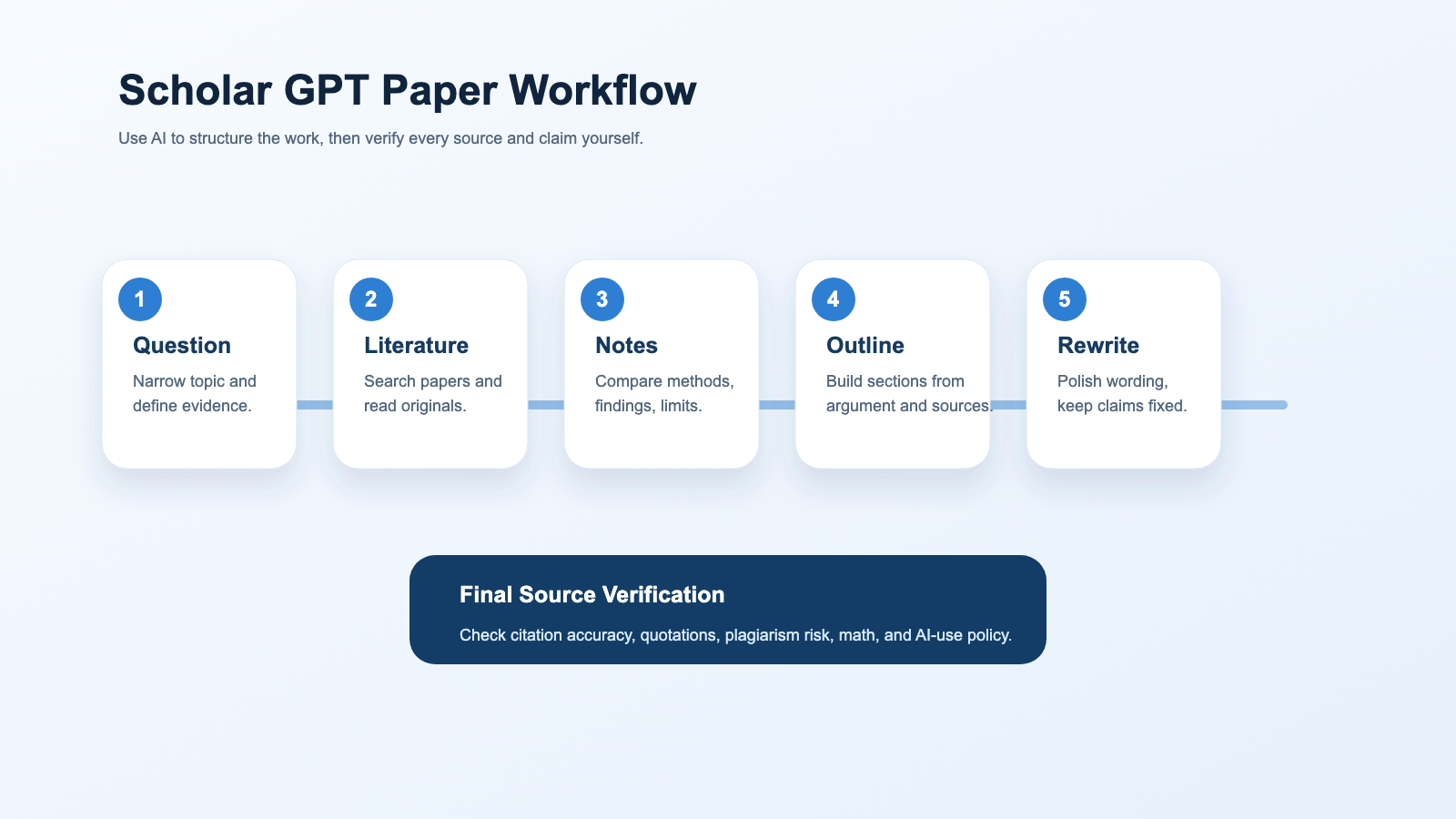
This workflow supports learning because it keeps you in control of interpretation. The AI helps reduce friction, but you still decide what sources matter, what claim your paper makes, and what evidence is strong enough to include.
Scholar GPT by Paperguide vs Scholargpt.ai: What Is the Difference?
The phrase "Scholar GPT by Paperguide" usually points to Paperguide's Scholar GPT - Free AI Research Tool for Scientific Research. That tool is positioned around literature discovery, scientific research search, and citation-backed answers. It is especially relevant when your main task is finding papers, asking research questions against academic sources, or building a citation-aware literature review workflow.
Scholargpt.ai has a broader academic-assistant angle. Its site presents ScholarGPT AI as a tool for learning, teaching, research, rewriting, and problem support, with separate tools such as AI Rewrite Text and AI Math Solver. That makes it useful when your paper workflow includes not only research discovery, but also paragraph refinement, academic tone, equations, statistics, and study support.
For practical use, the distinction is simple:
| Need | Better framing | What to verify |
|---|---|---|
| Literature discovery | Paperguide Scholar GPT for citation-backed research search | Whether cited papers exist and match the claim |
| Paper planning | Scholar GPT research workflow on Scholargpt.ai | Assignment scope, research question, and source quality |
| Rewriting | AI Rewrite Text for academic polishing | Meaning, citation support, and originality |
| Math or methods checking | AI Math Solver for step-by-step review | Formula assumptions, statistics, and instructor expectations |
| Final source review | AI checklist plus manual verification | Every citation, quotation, page number, and claim |
This naming clarification matters because searchers often use "Scholar GPT" as a general term. In a real paper workflow, you may use one tool for literature search and another for rewriting, math review, or draft organization.
Step-by-Step: How to Use Scholar GPT for Research and Paper Planning
Use how to use Scholar GPT for research prompts to make your topic smaller, clearer, and easier to research. Most weak papers start with a topic that is too broad, such as "AI in education" or "climate policy." ScholarGPT AI can help you turn that broad topic into a researchable question.
Start with your constraints. Tell the tool your course level, deadline, required citation style, word count, and whether the assignment is argumentative, analytical, experimental, reflective, or literature-based. Then ask for focused research questions, possible arguments, and search keywords.
Example workflow:
- Paste your assignment prompt.
- Ask for three possible research questions.
- Choose one question and ask what evidence would be required.
- Ask for a literature review structure organized by themes, not by one paper at a time.
- Build a source matrix with columns for research question, method, data, finding, limitation, and relevance to your paper.
This is where an AI research assistant for papers is most helpful. It gives structure before you draft, which reduces the risk of adding citations randomly after the paper is already written.
Use Scholar GPT as an AI Assistant for Literature Review, Not a Citation Shortcut
An AI assistant for literature review can help you understand, compare, and organize sources, but it should not replace source reading. Literature reviews depend on nuance: methods, populations, datasets, assumptions, limitations, and disagreements between studies all matter.
Ask for comparison tables rather than generic summaries. For example, paste your own source list and ask ScholarGPT AI to compare each paper by research question, method, data, key finding, limitation, and how it might support your argument. This keeps the AI grounded in the sources you selected and makes the output easier to verify.
When you use Paperguide Scholar GPT or another citation-backed research tool, still open the original paper. Confirm that the title, authors, journal, year, DOI, page numbers, and quoted findings are accurate. Research integrity problems are not hypothetical; AI-generated or AI-contaminated scholarly content has become a documented concern, which is why source verification belongs inside the workflow rather than at the end.
Use AI Rewrite Text to Polish Academic Paragraphs Without Changing Your Meaning
AI Rewrite Text is most useful after you have written a draft in your own words. Use it for abstracts, introductions, literature review paragraphs, methods explanations, discussion sections, and conclusion paragraphs that need clearer academic flow.
For academic writing, the goal is refinement, not disguise. A good AI text rewriter for academic writing should preserve your meaning, avoid adding unsupported claims, and improve sentence order, transitions, precision, and tone. If a rewritten paragraph sounds smoother but introduces a claim you did not prove, remove that claim.
Use AI Rewrite Text for tasks such as:
- rewrite research paper paragraphs that are repetitive or unclear.
- Use an AI paraphrasing tool for students to compare alternative wording, then revise manually.
- polish academic writing with AI before peer review, class submission, or supervisor feedback.
- Use an AI rewrite tool for paper drafts to tighten abstracts and introductions.
- Turn a rough literature review note into an academic paragraph rewriter task, while keeping citations attached.
The safest instruction is simple: "Do not add new claims." That one sentence prevents many problems.
Use AI Math Solver for Equations, Statistics, and Method-Checking Support
AI Math Solver can help when your paper includes formulas, statistics, calculations, or method explanations. It is useful for equation-heavy papers, statistics review, math homework, and method-checking support, especially when you need a step-by-step explanation before writing the method in academic language.
Use an AI math solver for students to understand the process, not only the answer. For example, you can ask it to explain what a formula measures, why a statistical method is used, what assumptions must hold, and what a result would mean in plain academic wording.
Good use cases include:
- solve research math problems with AI when checking intermediate calculations.
- Use an AI equation solver for papers to explain symbols and assumptions before writing a methods section.
- Ask an AI statistics problem solver to walk through regression, probability, hypothesis testing, or descriptive statistics.
- Use a step-by-step math solver AI to compare your own solution against another explanation.
- Get AI math help for academic work while still confirming formulas with your textbook, instructor, lab protocol, or statistical documentation.
For graded work, check your course policy before using AI help. For research papers, verify equations, assumptions, and statistical interpretation with original methods sources or a qualified reviewer when accuracy matters.
Reusable Scholar GPT Prompt Formula for Academic Papers
Use this formula when you want a clean, reusable prompt for Scholar GPT for students, academic writers, and researchers:
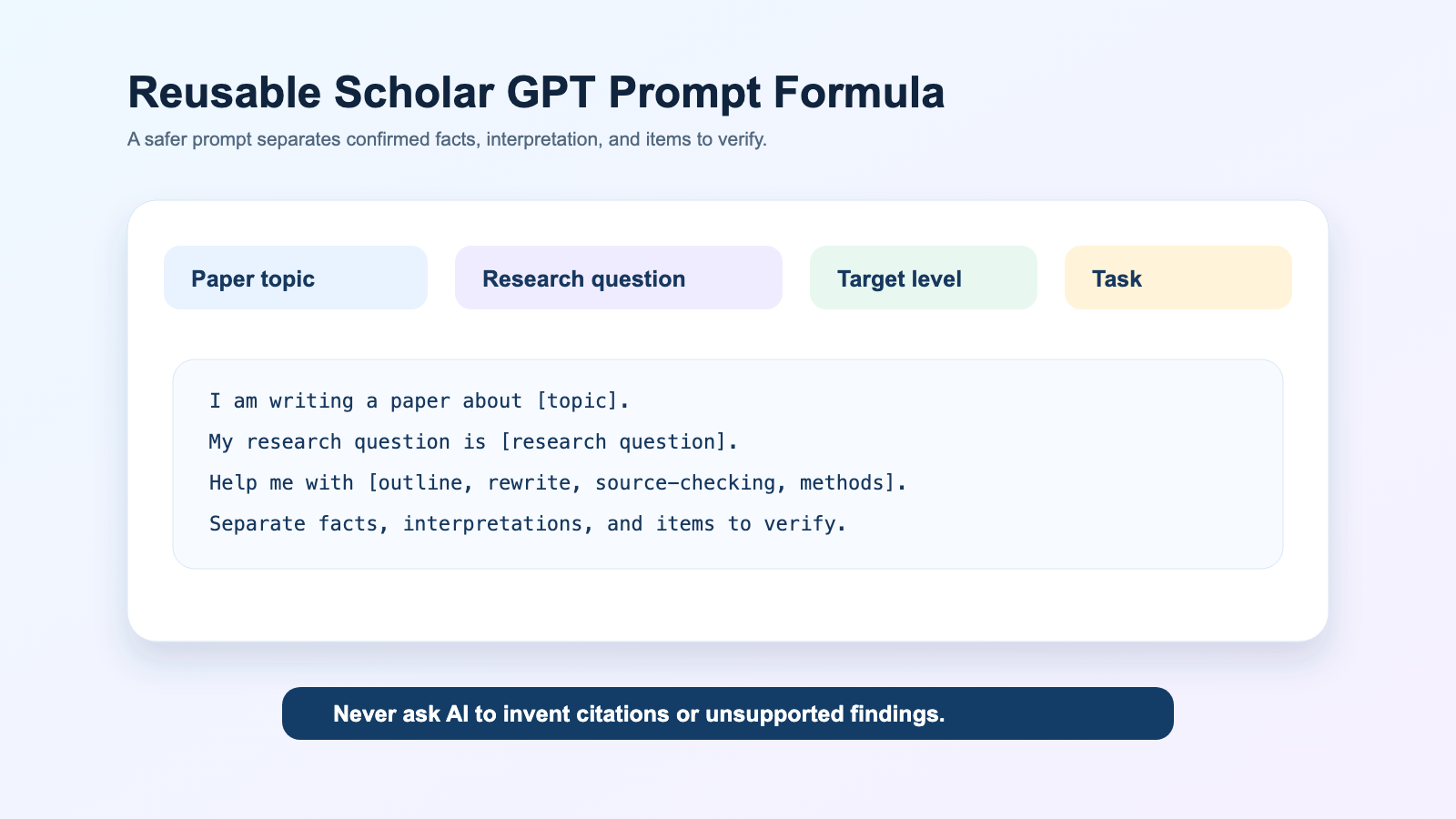
I am writing a paper about [topic]. My research question is [research question]. My target level is [undergraduate/master's/PhD/journal article]. Help me with [task: outline, literature review structure, paragraph rewrite, research gap, source-checking checklist, methods explanation]. Keep the output academic but clear. Separate confirmed facts, possible interpretations, and items I must verify from original sources.
This formula works because it tells the tool the paper topic, the level, the task, and the verification standard. The final sentence is important: it asks the AI to separate what is known, what is interpretive, and what needs manual checking.
Copy-to-Use Scholar GPT Prompts for Research, Rewrite, and Source Checking
Use these prompts as starting points. Replace bracketed text with your paper topic, draft paragraph, source list, or method details.
-
I am writing a paper about [topic]. Help me turn this broad topic into 3 focused research questions, each with a possible argument, required evidence, and keywords for literature search.
-
I am preparing a literature review on [topic]. Create a theme-based structure with 4-6 themes, explain what each theme should cover, and list what kind of sources I need for each section.
-
Rewrite this introduction paragraph to sound more academic and coherent while preserving my original meaning. Do not add unsupported claims: [paste paragraph].
-
I found these papers for my research topic. Help me compare them by research question, method, sample/data, key finding, limitation, and how I might use each one in my paper: [paste paper list].
-
Help me write a research gap paragraph for a paper about [topic]. Separate what previous studies have covered, what remains unclear, and why my paper's question matters.
-
Check this literature review paragraph for unsupported claims. Mark each sentence as "needs citation," "has citation but needs verification," or "general background": [paste paragraph].
-
Help me turn these messy notes into a paper outline with sections for introduction, background, literature review, methods, analysis, discussion, and conclusion: [paste notes].
-
Explain this equation/statistical method in simple academic language for a paper draft: [paste equation or method]. Include what it measures, why it is used, and what assumptions I should verify.
-
Rewrite this abstract to be clearer, more concise, and more suitable for an academic audience. Keep the same claims and do not invent findings: [paste abstract].
-
Create a source-checking checklist for my paper before submission, including citation accuracy, quotation accuracy, plagiarism risk, AI-use disclosure, and unsupported claims.
Source-Checking Checklist Before You Submit a Paper
Every AI-assisted paper needs a manual source-checking pass. This step protects you from fabricated citations, misread abstracts, inaccurate paraphrases, and over-polished claims that are not actually supported by the literature.
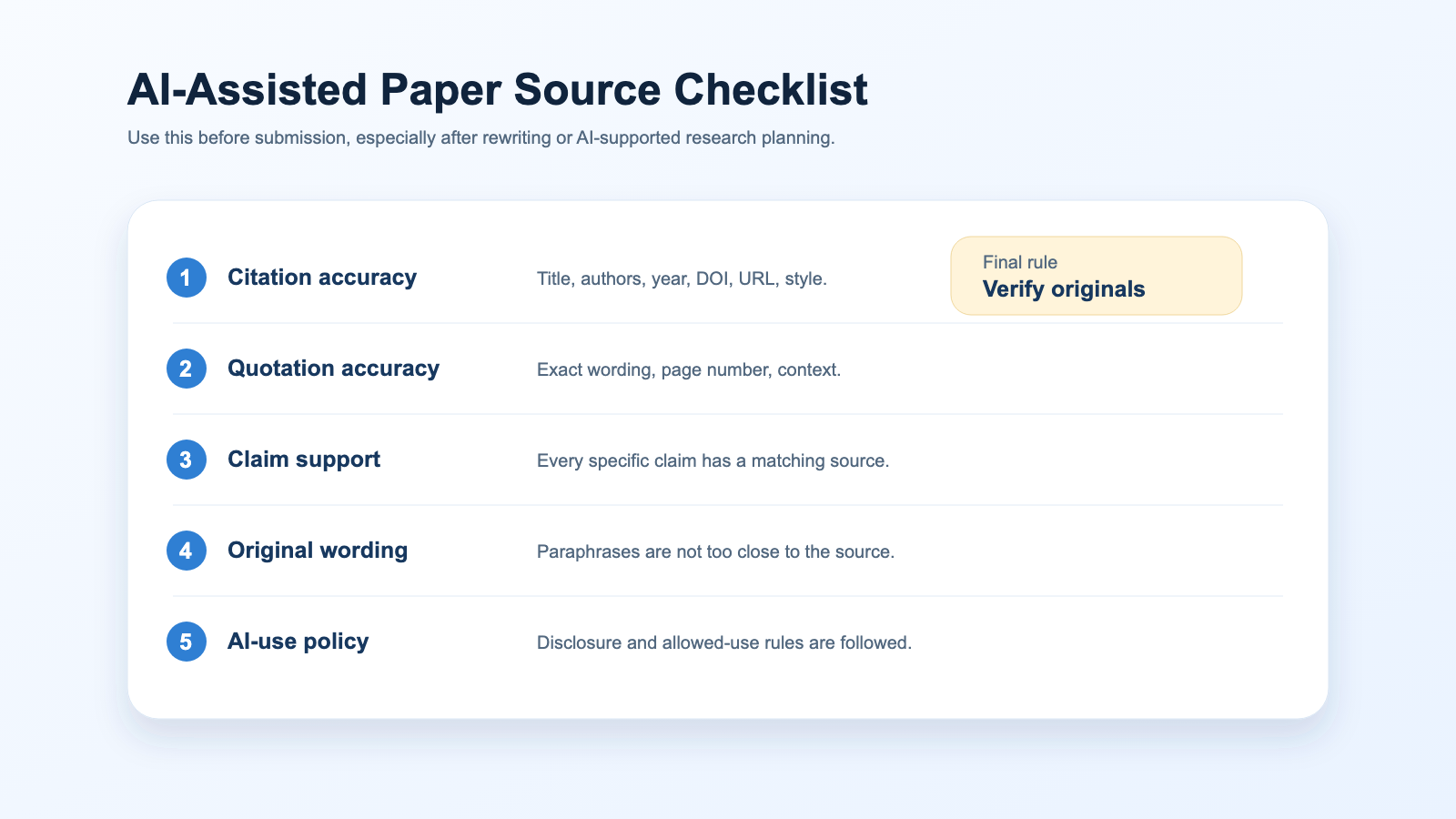
Before submission, check:
- Citation accuracy: title, authors, year, journal, DOI, URL, and citation style.
- Quotation accuracy: exact wording, page number, punctuation, and context.
- Claim support: every specific claim has a source that actually supports it.
- Paraphrase quality: the wording is original and not too close to the source.
- Literature balance: the paper does not ignore major counterarguments or limitations.
- Math and methods: equations, statistics, units, variables, and assumptions are correct.
- AI-use policy: the paper follows your school, instructor, conference, or journal rules.
- AI disclosure: any required acknowledgement is included in the correct format.
- Final responsibility: you can explain and defend every part of the paper yourself.
This checklist is not busywork. It is the difference between using an academic research AI assistant responsibly and submitting a document you have not fully verified.
Recommended Articles
- AI-Powered Research Assistants Explained: What They Do, How They Differ, and Where ScholarGPT AI Fits
- Rewrite Text AI with Scholar GPT AI: A Practical Guide to Rewriting, Rephrasing, and Polishing Text
- ScholarAI Review: What It Does Well, Where It Stands Out, and When a Simpler Academic Toolkit May Fit Better
- Scite AI Review: A Practical, Unbiased Look at Smart Citations, Research Discovery, and Academic Workflow
- Jenni AI Review: A Practical Look at What It Does Well, Where It Helps, and When a Simpler Tool May Be Enough
- ChatGPT 5.4 for Academic Research: A Practical, Unhyped Review
- Gemini Deep Research: Review + Hands-On Guide for Faster, More Trustworthy Research
People Also Read
- Scholar GPT - Free AI Research Tool for Scientific Research
- How to Use Scholar GPT for Literature Reviews in 2026
- 5 Best ScholarGPT Tools for Literature Review in 2026
- ScholarGPT: Fine-tuning Large Language Models for Discipline-Specific Academic Paper Writing
- GPT-fabricated Scientific Papers on Google Scholar
FAQ
Can Scholar GPT write my paper for me?
You should not use Scholar GPT as a blind paper-writing machine. Use it to plan, understand, organize, rewrite, and check your work, then verify all evidence and follow your institution's AI policy.
Is Scholar GPT good for literature reviews?
Yes, Scholar GPT-style tools can help structure literature review themes, compare papers, and identify research gaps. For citation-backed literature discovery, Paperguide Scholar GPT is especially relevant, but you still need to check original sources.
When should I use AI Rewrite Text?
Use AI Rewrite Text after you have your own draft. It is useful for polishing abstracts, introductions, literature review paragraphs, discussion sections, and academic tone while preserving your meaning.
When should I use AI Math Solver for a paper?
Use AI Math Solver when you need help explaining equations, checking calculations, reviewing statistics, or understanding a method. Always verify important math against course materials, original methods sources, or an expert reviewer.
How do I avoid plagiarism when using Scholar GPT?
Keep your own notes, cite original sources, avoid copying AI output without revision, check paraphrases against source text, and use AI as drafting support rather than as a substitute for your own argument.
Conclusion
Scholar GPT can be useful for academic papers when you use it as a structured assistant rather than a final authority. Use ScholarGPT AI for early planning, section organization, reading support, rewriting, math review, and source-checking prompts. Use Paperguide Scholar GPT when your priority is citation-backed literature discovery, and use Scholargpt.ai's AI Rewrite Text and AI Math Solver when your workflow needs polishing, explanation, and study support. The responsible finish is always human: verify sources, protect originality, follow AI-use policies, and submit only work you understand.