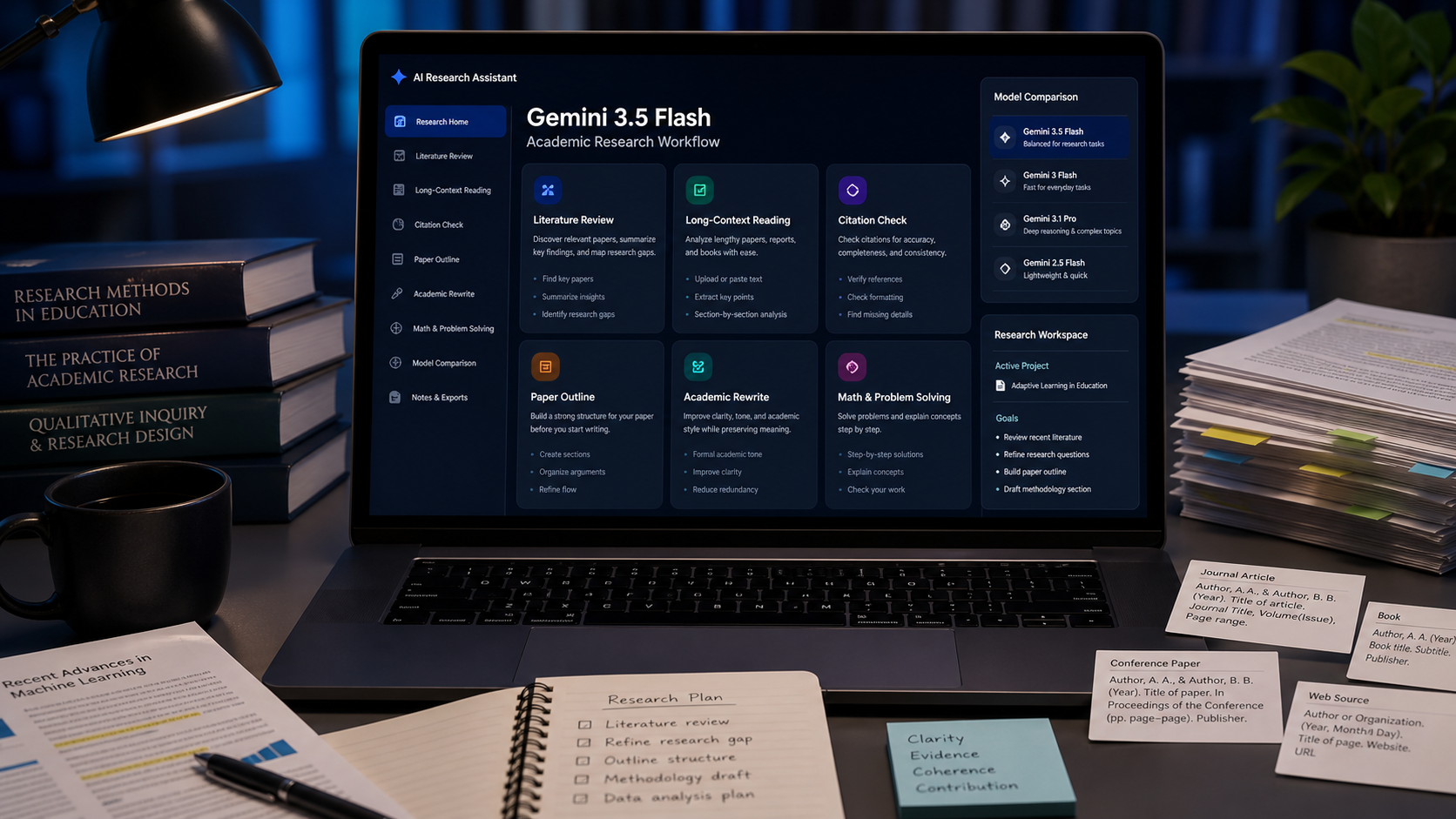
Gemini 3.5 Flash for research is worth reviewing because it combines a fast model profile with features that matter for academic work: long-context reading, structured output, coding support, tool use, and multi-step reasoning. For students, researchers, teachers, academic writers, and knowledge workers, the practical question is not whether Gemini 3.5 Flash can "do research" by itself. The better question is whether it can help organize, inspect, rewrite, and plan research work while you still verify every source and claim.

Quick Summary: Gemini 3.5 Flash for Research
Gemini 3.5 Flash looks useful for academic workflows that involve long documents, messy notes, structured outlines, coding support, data interpretation, and repeated review tasks. Google's current docs list gemini-3.5-flash as a stable model with a 1,048,576 token input limit, a 65,536 token output limit, thinking support, code execution, file search, Google Search grounding, URL context, function calling, and structured outputs.
That does not make it an academic authority. AI research tools can hallucinate citations, misread papers, compress nuance too aggressively, and produce unsupported claims in polished language. For serious academic use, Gemini 3.5 Flash should be treated as a research assistant, not a replacement for original papers, peer-reviewed databases, advisor feedback, or human judgment.
Key takeaways
- Gemini 3.5 Flash may be strong for long-context academic tasks such as article summarization, paper comparison, research-note organization, and project planning.
- It can help with coding, data interpretation, methods explanation, and structured writing support, but outputs need human review.
- ScholarGPT AI is a simpler academic toolkit for students who want focused support around rewriting, math solving, study help, and paper workflow organization.
- AI Rewrite Text is useful for polishing research paragraphs without adding new claims.
- AI Math Solver can help explain equations, methods, and technical problems step by step.
- For any academic use, verify sources, citations, quotes, paraphrases, methods, and school or journal AI policies before submission.

What Gemini 3.5 Flash Can Help With in Academic Work
Gemini 3.5 Flash is most useful when research work needs structure, synthesis, and repeated iteration. It can help turn a broad topic into research questions, convert messy notes into an outline, compare article abstracts, summarize a long paper, explain a statistical method, or plan the next week of reading and drafting.
The strongest academic use cases are workflow tasks, not final authority tasks:
- Literature reading: summarize purpose, method, findings, limitations, and relevance.
- Long-context summarization: process long documents, notes, transcripts, or article excerpts while preserving section structure.
- Source organization: group papers by theme, method, dataset, theory, or debate.
- Structured outlines: build article, thesis, or seminar-paper outlines from notes.
- Coding support: review research scripts, debugging plans, data-cleaning steps, or analysis code.
- Data interpretation: identify trends, anomalies, possible explanations, and questions to verify.
- Academic writing support: rewrite paragraphs for clarity while preserving meaning.
- Project planning: create reading schedules, writing milestones, and source-checking steps.
The limitation is equally important: Gemini 3.5 Flash does not know whether your pasted article excerpt is complete, whether a citation is accurate, whether a method is appropriate for your field, or whether your institution allows a specific AI use. It can support academic work, but it cannot remove your responsibility to read, verify, cite, and disclose properly.
As a practical review, Gemini 3.5 Flash is promising for research preparation and review. It is less appropriate as a one-click tool for producing final claims, final citations, or finished academic writing.

Gemini 3.5 Flash vs ScholarGPT AI Research Workflows
Gemini 3.5 Flash and ScholarGPT AI fit different parts of a research workflow. Gemini 3.5 Flash is a general model with long-context and agentic strengths. ScholarGPT AI is better framed as an accessible academic toolkit for focused student tasks such as rewriting, math support, studying, paper workflow help, and research organization.
For many students, that distinction matters. A powerful model can be flexible, but it may require better prompts and more careful verification. A focused academic toolkit can be easier to use when the task is narrow: rewrite a paragraph, clarify a math problem, organize notes, or get study support.
| Workflow need | Gemini 3.5 Flash fit | ScholarGPT AI fit |
|---|---|---|
| Long-context article analysis | Strong candidate when you paste long text and request structured extraction | Useful as part of a broader paper workflow if you want academic task framing |
| Literature review planning | Good for theme maps, research gaps, outlines, and comparison tables | Useful for students who want simpler research-assistant guidance |
| Academic paragraph polishing | Good when prompted not to add claims or citations | AI Rewrite Text is the more focused tool for rewriting and polishing |
| Equations and methods | Can explain methods, assumptions, and reporting requirements | AI Math Solver is better aligned with step-by-step math and technical help |
| Coding and data scripts | Useful for debugging, explaining scripts, and planning analysis code | Less central unless the work is framed as study or technical support |
| Source verification | Can help build checklists and flag claims to verify | Still requires original-source checking, regardless of tool |
The best practical setup is not either-or. Use Gemini 3.5 Flash for broad, long-context, multi-step research analysis. Use ScholarGPT AI when you want a simpler academic interface for rewriting, math clarification, study help, and paper workflow support.

How to Use an AI Research Assistant Without Losing Academic Control
An AI research assistant is most useful when it helps you ask better questions and inspect material more carefully. It becomes risky when it replaces reading, verification, or citation discipline. The safest research workflow keeps AI in the middle of the process, not at the end.
Use this workflow:
- Define the research question. Ask AI to narrow a broad topic, but choose the final question yourself.
- Search trusted databases. Use library databases, Google Scholar, publisher sites, institutional access, or field-specific indexes.
- Read original sources. Use AI summaries only after you have access to the paper or excerpt you need to verify.
- Create structured notes. Ask Gemini 3.5 Flash to separate purpose, method, finding, limitation, and relevance.
- Compare sources by theme. Group papers by theory, method, sample, evidence, and disagreement.
- Draft an outline. Use AI to organize your argument, not to invent the argument.
- Write and rewrite carefully. Use tools such as AI Rewrite Text to improve clarity without adding claims.
- Verify everything. Check citations, quotes, paraphrases, methods, numbers, and claims against original sources.
This workflow also helps avoid plagiarism. If AI rewrites a paragraph, compare it with your original meaning and sources. If AI suggests a claim, find the original evidence before using it. If your school or journal requires disclosure, document how you used AI and follow the policy exactly.
The point is control. AI can speed up research organization, but academic credibility still comes from traceable sources and honest reasoning.

Reusable Gemini 3.5 Flash Research Review Prompt Formula
A good academic prompt asks the model to separate evidence from interpretation. That is especially important for Gemini 3.5 Flash for literature review tasks, because polished summaries can hide uncertainty if you do not force the model to label what must be verified.
Copy this formula:
I am testing Gemini 3.5 Flash for a research task. My topic is [topic]. My research question is [research question]. My academic level is [undergraduate/master's/PhD/professional]. Help me with [task: literature review, outline, source comparison, research gap, methods explanation, data interpretation, paragraph rewrite]. Separate confirmed facts, possible interpretations, assumptions, and items I must verify from original sources.
Use these copy-to-use prompts for research workflows:
- I am writing a paper about [topic]. Help me turn this broad topic into 5 focused research questions. For each one, include possible argument, required evidence, keywords for literature search, and likely limitations.
- I am preparing a literature review on [topic]. Create a theme-based structure with 5 sections. For each section, explain what kind of sources I need and what claims I should avoid making without evidence.
- Compare these papers by research question, method, dataset/sample, key finding, limitation, and how I might use each one in my paper: [paste paper list or abstracts].
- Summarize this research article for academic use. Separate purpose, method, findings, limitations, and possible relevance to my research question: [paste article text].
- Help me identify the research gap in these notes. Separate what previous studies have already covered, what remains unclear, and what my paper could contribute: [paste notes].
- Rewrite this literature review paragraph to sound clearer and more academic while preserving my original meaning. Do not add claims or citations: [paste paragraph].
- Check this paragraph for unsupported claims. Mark each sentence as "needs citation," "general background," "interpretation," or "must verify from source": [paste paragraph].
- Explain this statistical method in simple academic language. Include what it measures, why it is used, assumptions, weaknesses, and what I should report in a paper: [paste method/equation].
- Turn these messy research notes into a structured outline with introduction, background, literature review, methods, analysis, discussion, and conclusion: [paste notes].
- Create a research workflow for the next 7 days. My paper topic is [topic], deadline is [deadline], and current progress is [progress]. Include reading, note-taking, outlining, drafting, and source-checking steps.
- I want to test Gemini 3.5 Flash for long-context research. Analyze this long document and return key arguments, evidence, contradictions, missing citations, and possible follow-up questions: [paste document].
- Create a final source-checking checklist for my paper. Include citation accuracy, quote accuracy, paraphrase risk, AI-use disclosure, source credibility, methodology accuracy, and unsupported claim review.
The most useful prompt phrase is often "do not add claims or citations." It prevents the model from making the draft sound more authoritative than the evidence supports.

ScholarGPT AI for Rewriting, Math, and Focused Study Support
ScholarGPT AI is a practical companion when a research task is narrow and academic. Instead of asking a general model to do everything, users can move focused tasks into dedicated academic tools such as AI Rewrite Text and AI Math Solver.
Use AI Rewrite Text when your paragraph already has the right meaning but needs clearer language. The safest prompt is specific: "Improve clarity and flow, preserve my original meaning, do not add new claims, do not add citations, and keep a formal academic tone." That keeps the tool in an editing role instead of turning it into an unsupported claim generator.
Use AI Math Solver when you need help understanding formulas, equations, statistics, or technical problem steps. For research-heavy work, ask it to explain what a method measures, why it is used, what assumptions it requires, what weaknesses it has, and what should be reported in a paper. Then confirm the explanation with your textbook, course materials, methods papers, or advisor guidance.
This focused-tool approach is useful for students because it reduces prompt overhead. Gemini 3.5 Flash may be stronger for broad long-context research review, while ScholarGPT AI may be easier for routine academic tasks: rewriting a literature review paragraph, clarifying a calculation, organizing notes, or reviewing a paper workflow.

Risks: Hallucinated Citations, Misread Papers, and Unsupported Claims
The main risk with any academic research AI assistant is false confidence. AI tools can produce fluent summaries that look academic but contain incorrect citations, missing context, invented details, or simplified evidence. Research is especially vulnerable because small errors in method, sample, quote wording, or citation attribution can change the meaning of a paper.
Before using AI output in academic work, check:
- Citation accuracy: Does the cited paper exist, and does it say what the AI claims?
- Quote accuracy: Is the quote exact, page-correct, and used in context?
- Paraphrase risk: Is the rewritten sentence too close to the source or too far from the evidence?
- Methodology accuracy: Did the AI describe the method, sample, variables, or limitations correctly?
- Unsupported claims: Which sentences need citations or original evidence?
- Source credibility: Is the source peer-reviewed, primary, relevant, and current enough for the claim?
- AI disclosure: Does your school, journal, instructor, or publisher require disclosure?
- Plagiarism policy: Does your use of rewriting or paraphrasing follow academic integrity rules?
There is also a broader evidence-quality problem. Research on fabricated scientific papers appearing in Google Scholar has shown how AI-generated or low-quality material can pollute discovery environments. That makes source verification more important, not less. If AI suggests a source, claim, or citation trail, follow it back to the original publication before relying on it.
For academic work, "trust but verify" is too soft. A better rule is: use AI to organize, then verify before believing.

FAQ: Gemini 3.5 Flash Research Review
Is Gemini 3.5 Flash useful for literature reviews?
Yes, Gemini 3.5 Flash can be useful for organizing literature review themes, summarizing article excerpts, comparing abstracts, and identifying possible gaps. It should not be trusted to invent citations or replace your own reading of original papers.
Can Gemini 3.5 Flash write my research paper?
It can help with outlines, paragraph clarity, note organization, and revision planning, but it should not be used as an automatic paper writer. Academic work needs your argument, verified sources, proper citations, and compliance with school or journal policy.
Is ScholarGPT AI better than Gemini 3.5 Flash for students?
It depends on the task. Gemini 3.5 Flash may be stronger for broad, long-context, multi-step research review. ScholarGPT AI may be easier for focused student workflows such as rewriting academic paragraphs, math clarification, study support, and research task organization.
Can AI Rewrite Text help with academic writing?
Yes, AI Rewrite Text can help polish research paragraphs, improve flow, and make wording clearer. The safe use case is editing your own draft without adding new claims, fake citations, or unsupported evidence.
Can AI Math Solver help with research methods?
Yes, AI Math Solver can help explain equations, statistics, and technical steps. You should still verify technical details with course materials, textbooks, original methods papers, or a qualified instructor.
What should I never outsource to AI in academic work?
Do not outsource final source verification, final citation accuracy, final interpretation of evidence, academic integrity decisions, or policy compliance. AI can support those tasks, but the responsibility remains with the writer.

Conclusion: Is Gemini 3.5 Flash Useful for Academic Work?
Gemini 3.5 Flash for research is useful when you treat it as a fast, structured research assistant for reading support, long-context summarization, outlining, coding help, data interpretation, and project planning. It is not a substitute for peer-reviewed sources, original reading, citation checking, or academic judgment.
For the most balanced workflow, use Gemini 3.5 Flash for broad research review and multi-step organization, then use ScholarGPT AI for focused academic tools such as rewriting, math solving, and student-friendly paper workflow support. Before publishing or submitting anything, verify every source, check every claim, follow your institution's AI policy, and disclose AI use when required.
Recommended articles
- AI-Powered Research Assistants Explained: What They Do, How They Differ, and Where ScholarGPT AI Fits
- Gemini Deep Research: Review + Hands-On Guide for Faster, More Trustworthy Research
- ChatGPT 5.4 for Academic Research: A Practical, Unhyped Review
- Scite AI Review: A Practical, Unbiased Look at Smart Citations, Research Discovery, and Academic Workflow
- ScholarAI Review: What It Does Well, Where It Stands Out, and When a Simpler Academic Toolkit May Fit Better
- Jenni AI Review: A Practical Look at What It Does Well, Where It Helps, and When a Simpler Tool May Be Enough
People also read
- Gemini 3.5: Frontier Intelligence with Action
- What's New in Gemini 3.5 Flash
- Gemini 3.5 Flash Model Card
- Grounding with Google Search
- Scholar GPT by Paperguide
- GPT-fabricated Scientific Papers on Google Scholar